


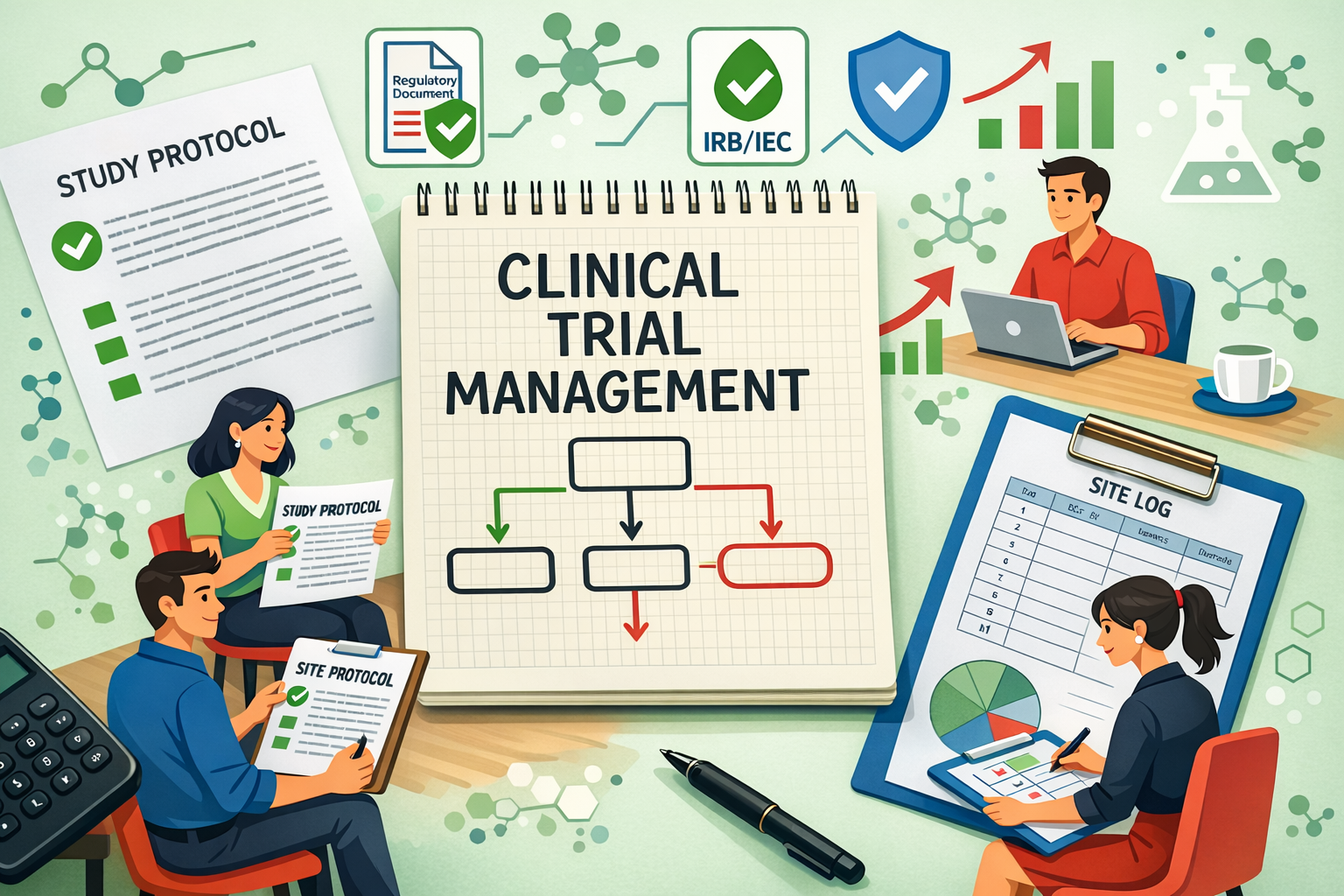
Clinical Trial Management : A Strategic Guide for Sponsor and CRO Leaders
In the intricate world of clinical research, Clinical Trial Managers (CTMs) at sponsor companies and Contract Research Organizations (CROs) serve as the critical bridge between science and execution. Their ability to manage sites, data, timelines, and compliance defines not just the success of a trial but also the reputation and financial health of the organization. This article offers an advanced guide for CTMs on optimizing day-to-day clinical operations, fostering strong site relationships, and navigating challenges with strategic foresight.
1. Building a Foundation of Proactive Site Management
Effective site management begins long before the first subject is enrolled.
-
Site selection based on performance data: Use feasibility studies, past enrollment metrics, and investigator responsiveness to select high-performing sites—not just by geography, but by proven capability.
-
Pre-site relationship cultivation: Initiate engagement during feasibility to set expectations, gauge enthusiasm, and assess resource availability.
-
Site-specific customization: Provide tailored support to sites based on their experience level, infrastructure, and staff turnover rate.
Pro Tip: Establish early contact with the site’s Clinical Research Coordinator (CRC)—they’re often the real engine behind recruitment and data quality.
2. Designing a Blueprint for Operational Excellence
CTMs are orchestrators of people, processes, and timelines. Operational clarity prevents drift and delays.
-
Define roles with surgical precision: Ensure that responsibilities between sponsor, CRO, and site staff are clearly demarcated. Avoid duplication or assumption gaps.
-
Leverage centralized platforms: Use real-time dashboards and CTMS systems to unify communication, track milestones, and flag bottlenecks.
-
Standardize visit plans: Harmonize monitoring visit schedules with clear expectations for document review, source verification, and issue resolution.
Quick Tip: Implement “study pulse checks” every two weeks—brief, structured updates with site leads to catch early deviations or resource issues.
3. Maintaining Oversight Without Micromanagement
CROs and sponsors often walk a tightrope—balancing oversight with operational autonomy.
-
Develop risk-based monitoring (RBM) plans: Focus effort where it matters—on critical data points, protocol compliance, and high-risk sites.
-
Audit-ready documentation systems: From trial master files to SAE narratives, build systems that maintain inspection readiness continuously—not just before an audit.
-
Tiered escalation pathways: Not every deviation needs a fire drill. Have structured levels of escalation and predefined corrective action protocols.
Success Metric: A well-run trial should minimize the number of protocol deviations per enrolled subject and maintain a high monitor visit completion rate.
4. Mastering Communication Across Stakeholders
In multi-site, multi-country trials, communication is a strategic function, not just an operational task.
-
Centralize sponsor messaging: Involve all functional leads (medical, regulatory, data) in unified, concise site communications to reduce noise.
-
Use layered feedback loops: Combine formal mechanisms (monthly reports, KPIs) with informal feedback (surveys, CRC calls) to understand site sentiment.
-
Cultural and regional awareness: Communication norms differ—what works in Germany may be inappropriate in India. Tailor engagement style accordingly.
Tool Tip: Deploy a secure communication hub (e.g., eTMF-integrated discussion boards) to archive decisions and minimize email sprawl.
5. Day-to-Day Operations: Streamlined Yet Flexible
Each day in clinical operations brings unpredictable variables. Agility must be embedded in process.
-
Morning task triage: Implement a “priority first” system—focus on safety events, enrollment issues, and data locks before administrative tasks.
-
Batch routine workflows: Group low-urgency tasks (like invoice tracking or meeting summaries) into specific time slots to maintain deep focus.
-
Empower local monitors: Give field staff autonomy to make real-time decisions within a predefined scope, improving responsiveness and morale.
Key Habit: Document decisions daily—brief rationales behind timeline shifts, site queries, or data changes build a defensible audit trail.
6. Navigating Common Challenges with Resilience
Clinical trials never go entirely to plan. Proactive mitigation strategies distinguish seasoned CTMs.
| Challenge | Mitigation Strategy |
|---|---|
| Slow recruitment | Add rescue sites early; deploy pre-screening logs to track drop-off causes. |
| Data entry delays | Integrate auto-reminders in EDC; incentivize data lock milestones. |
| High CRA turnover | Maintain robust handover tools (site synopsis, monitoring logs). |
| Site disengagement | Use site health dashboards; prioritize personal engagement from lead CTMs. |
| Regulatory delays | Prepare parallel submission packages; use regulatory intelligence platforms. |
Mindset Shift: View obstacles not as failures but as optimization triggers.
7. Path to Success: Leadership, Influence, and Innovation
Great CTMs are not just project managers—they are operational leaders.
-
Lead through influence, not control: Build credibility with sites and internal teams by being responsive, knowledgeable, and calm under pressure.
-
Champion innovation: Encourage adoption of tools like eConsent, ePRO, or decentralized trial platforms—when appropriate.
-
Invest in yourself: Seek advanced certifications (e.g., CCRP, PMP, CCRA), attend global investigator meetings, and participate in regulatory webinars.
Conclusion: Redefining Success in Clinical Trial Oversight
The modern CTM must blend project discipline with emotional intelligence, tech fluency with regulatory expertise. Whether in a CRO or sponsor seat, the impact of your decisions reverberates through timelines, budgets, and—most importantly—patient lives. When trial management is done well, it’s invisible. But its effects are transformative.

Excellent post!! Please share more insights.
Great post.