


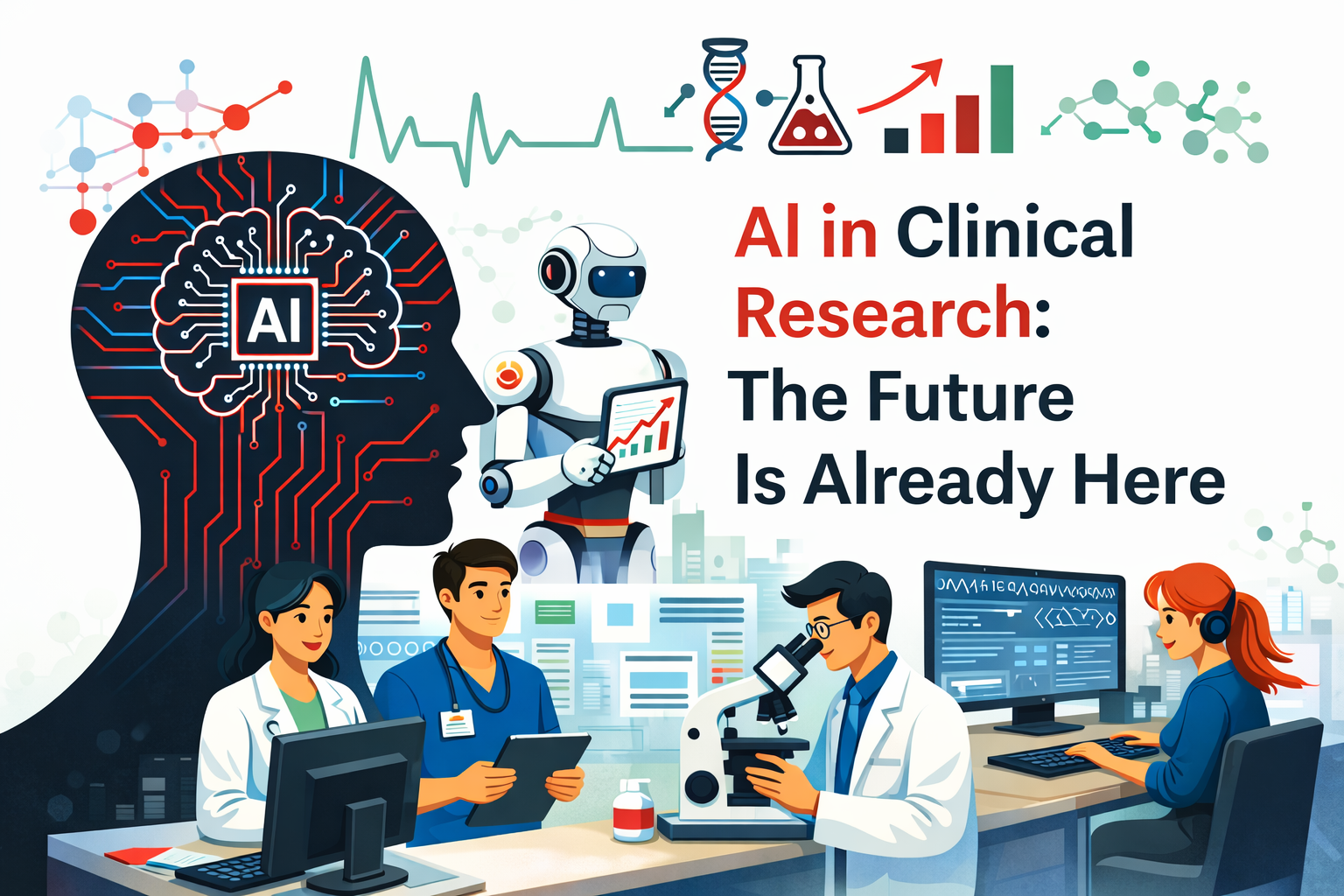
Clinical research is entering a new era—one where machines don’t replace scientists, but work alongside them to unlock smarter, faster, and more patient-centered trials. At the center of this shift is Artificial Intelligence (AI)—no longer a futuristic buzzword, but a tangible force driving real-world change across the research ecosystem.
Beyond Buzz: What AI Really Brings to Clinical Research
AI in clinical trials isn’t about humanoid robots in lab coats. It’s about sophisticated algorithms that analyze patterns, learn from vast datasets, and offer predictive insights faster than any human team ever could.
From matching patients to trials in seconds, to predicting protocol deviations before they happen, AI is turning reactive workflows into proactive strategies.
Let’s break down how it’s already reshaping the field—and what lies ahead.
1. Smarter Study Design: From Months to Minutes
Traditionally, protocol design was driven by precedent, expert consensus, and trial-and-error. Today, AI tools simulate study outcomes before a single patient is enrolled.
Imagine being able to:
-
Model recruitment outcomes by geography
-
Test protocol feasibility using real-world data
-
Predict dropout rates and optimize visit schedules
Platforms like Medidata and Saama are already enabling this, reducing design time from months to weeks and improving success probabilities.
2. Transforming Patient Recruitment and Diversity
Recruiting the right participants is one of the most painful bottlenecks in clinical trials. AI is slashing this burden by:
-
Analyzing electronic health records (EHRs) to identify eligible patients
-
Using natural language processing (NLP) to interpret physician notes and match patients to inclusion criteria
-
Tailoring recruitment campaigns by geography, demographics, and digital behavior
This doesn’t just improve speed—it helps ensure trials represent the populations they aim to serve.
? Future Insight:
Within the next 3–5 years, expect AI-powered platforms to connect patients directly to trials via mobile apps, smart devices, and even voice assistants—creating a patient-first ecosystem.
3. Reinventing Monitoring: From Manual to Predictive
Site monitoring is evolving. AI can now:
-
Flag anomalies in trial data across hundreds of sites
-
Detect emerging safety signals from patient-reported outcomes or wearable devices
-
Prioritize monitoring visits based on algorithmic risk scores
This shifts the role of CRAs (Clinical Research Associates) from data collectors to data interpreters—critical thinkers guiding decisions, not just documenting them.
4. Real-Time Regulatory Strategy
Regulatory bodies like the FDA and EMA are increasingly open to AI. The FDA’s Real-Time Oncology Review program now allows early data submission, and the future likely holds:
-
Algorithm-assisted risk-benefit evaluations
-
Digital twins (simulated patient profiles) supporting adaptive approvals
-
Greater reliance on AI-validated real-world evidence
But this demands transparency. The so-called “black box” problem—when we can’t explain how an algorithm arrived at a decision—remains a barrier.
5. The Human Element: Still Irreplaceable
AI will not replace clinical research professionals. But professionals who understand and embrace AI will undoubtedly replace those who don’t.
Success in this new era requires:
-
Data literacy
-
Familiarity with AI tools and dashboards
-
The ability to question AI outputs with scientific rigor
-
A collaborative mindset across clinical, data science, and regulatory teams
Where Are We Headed?
The future isn’t AI versus human—it’s AI with human. Picture a trial where:
-
Protocols are optimized before IRB submission
-
Patients are recruited via personalized digital campaigns
-
CRAs work from centralized command centers powered by real-time dashboards
-
Submission dossiers include AI-assisted statistical models validated against real-world data
We’re not dreaming. We’re building.
Final Thoughts: A Call to the Clinical Research Community
AI is not a shortcut. It’s a catalyst. A tool that demands stewardship, ethics, and vision.
For clinical research professionals, now is the time to learn, adapt, and lead. Read about it. Test it. Challenge it. But don’t ignore it. Because the trials of the future—and the lives they save—will depend on how boldly we step into this intelligent era.

Post us your thoughts.